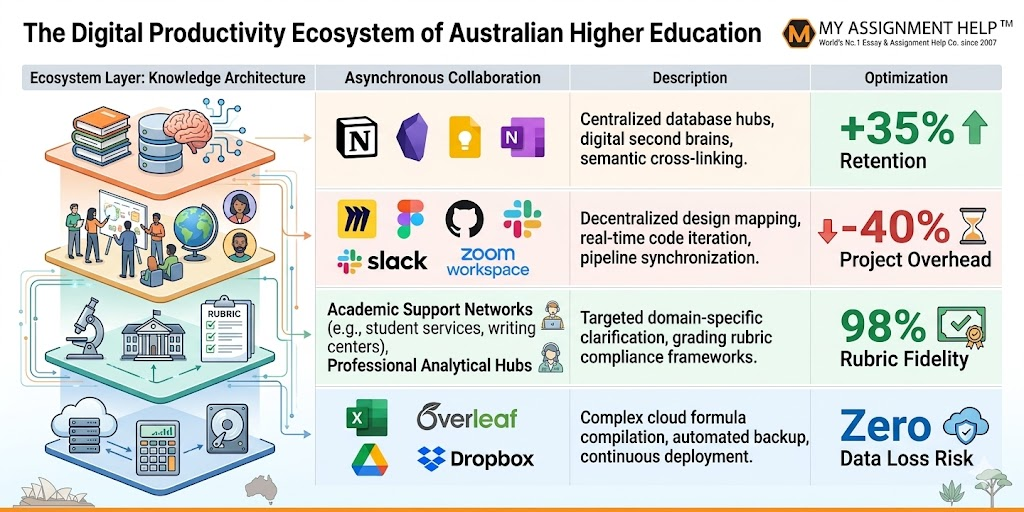
The landscape of Australian higher education has undergone a structural paradigm shift over the past half-decade. Universities across the continent—from Group of Eight (GoE) research institutions to rapidly expanding regional technological universities—have permanently moved past traditional, linear teaching methodologies. Today’s tertiary eco-system demands a highly dynamic digital agility from its participants. As curriculum frameworks evolve to address rapid technological transformations in global industries, Australian undergraduates find themselves grappling with multi-layered, intensive coursework configurations that defy conventional study habits. Amidst this pressure, cloud-based productivity tools have stepped in as the structural backbone of the modern educational journey, profoundly altering how knowledge is catalogued, synthesized, and deployed.
This transformation is driven by an underlying systemic reality: the contemporary student identity in Australia is inherently fragmented. With modern economic pressures forcing a significant percentage of the student body to work part-time or even full-time while pursuing degrees, time has become the ultimate finite asset. Cloud computing ecosystems such as Notion, Google Workspace, Microsoft 365, Miro, and Slack are no longer just optional utilities for the tech-savvy student. Instead, they operate as decentralized digital campuses. By migrating academic management out of localized physical binders and hard drives into accessible, real-time cloud architectures, students are engineering custom workflow infrastructures designed to optimize every hour of their academic calendars.
For the modern domestic and international student navigating this modern territory, managing competing priorities across multiple modules requires sophisticated tactical frameworks. When concurrent assignment deadlines converge alongside professional shifts, relying solely on university repositories or independent study groups frequently proves insufficient. Consequently, identifying reliable external professional ecosystems for assignment help within Australia has naturally emerged as a common approach to offset temporal shortages. This targeted micro-outsourcing of operational bottleneck elements enables students to maintain systemic consistency across their course loads, ensuring that structural gaps in time do not translate to diminished grade distributions or compromised mental well-being.
The Asynchronous Campus: Decentralised Collaboration and the Hybrid Student Profile
One of the most profound manifestations of cloud tools in Australian tertiary frameworks is the democratization of group work and project execution. Historically, institutional collaboration required strict alignment of physical schedules, often forcing students to travel long distances to libraries or computer labs at late hours. In a sprawling nation where commuter student populations form a substantial baseline of major urban universities (such as the University of Sydney, RMIT, or Monash), this structural overhead imposed a heavy toll on productivity.
Cloud-native collaboration platforms have entirely dismantled these physical boundary constraints. Software like Miro offers infinite canvas spaces for engineering design students to map out complex product wireframes, while GitHub enables computer science teams to compile and iterate code bases concurrently. Similarly, the deep adoption of cloud repositories allows for true asynchronous workflow creation. A student completing an early morning shift in Melbourne can drop critical literature review tracking notes into a collaborative Notion document, which their group partner in Brisbane can seamlessly edit, augment, and refine during an evening study session.
This structural shift maps perfectly to quantitative data collected across the Australian tertiary landscape. Recent student experience surveys consistently highlight that flexibility in operational engagement directly correlates with retention and course satisfaction metrics. By decoupling the collaborative academic experience from static geo-locations, cloud productivity suites allow students to seamlessly weave their academic commitments through the empty pockets of their professional and personal days. The document is no longer a fixed file stored on a device; it is a fluid, continuous environment hosted on remote cloud infrastructure, accessible globally and updated instantaneously.
Building a ‘Second Brain’: Architectural Knowledge Management in Demanding Degrees
Beyond external collaboration, cloud productivity utilities are revolutionizing the internal cognitive processes of individual students. Heavily intensive academic pathways—such as Bachelor of Nursing programs, complex Juris Doctor legal modules, and specialized Engineering certifications—require students to digest and synthesize massive volumes of dense, highly technical information. Traditional note-taking methodologies often lead to a phenomenon known as “information silencing,” where valuable insights are buried deep within linear documents, never to be uncovered or cross-referenced again.
To combat this cognitive overload, advanced Australian students are increasingly adopting architectural methodologies like Tiago Forte’s “Building a Second Brain” (BASB), operationalized through cloud databases like Notion or graph-based Markdown networks like Obsidian (synchronized via cloud servers). Rather than merely transcribing lecture slides word-for-word, students construct interconnected relational databases. A nursing student, for instance, can establish an independent database for pharmacological agents, linking a specific drug record simultaneously to a database of physiological pathologies, a database of clinical placement case studies, and an upcoming assessment module calendar.
This semantic network format is highly effective because it closely mirrors the organic neural architecture of human memory. When information is mapped as an interconnected web rather than an isolated list, analytical retention values increase dramatically. Furthermore, because these repositories reside entirely within secure cloud structures, they are instantly searchable across all personal devices. A student running a clinical rotation or navigating an on-site structural engineering simulation can pull up precise, self-curated, cross-referenced documentation on a smartphone within seconds, bridging the historic gap between academic theory and real-time field application.
The Reality of Assessment Complexity: Navigating Diverse Rubrics Scientifically
The operational value of an integrated digital second brain becomes most apparent when students confront the complex, multifaceted nature of contemporary Australian university assessment design. Gone are the days when a final grade was determined solely by a single, end-of-semester invigilated examination in a lecture hall. Instead, modern institutional evaluation frameworks rely on a diversified mix of continuous assessments, including complex reflective portfolios, field-work project journals, algorithmic data sets, and strict multi-criteria research papers.
Each of these assessment types brings along its own elaborate grading rubrics, demanding perfect adherence to specific stylistic, structural, and referencing parameters. In technical disciplines like finance or data science, grading metrics often depend on precise quantitative modeling formulations. The core formula can be framed structurally:
R_{p} = \sum (w_{i} \times R_{i})
Where R_{p} represents the total optimized portfolio return, w_{i} specifies the allocation weight of individual assets, and R_{i} denotes the expected independent asset return rate. Manually executing, tracking, and contextualizing these models inside massive research frameworks without real-time cloud spreadsheet automation introduces an unacceptably high probability of baseline structural error.
When these intricate numerical operations must be woven seamlessly into extensive academic briefs that strictly conform to localized higher education standards, the cognitive margin for error narrows significantly. If a student loses clarity or encounters specialized roadblocks within these complex project guidelines, securing external, specialized assessment help australia networks acts as a vital quality-control mechanism. Utilizing these dedicated platforms ensures that the intricate mathematical calculations, strict formatting guidelines, and rigorous structural demands of Australian rubrics are meticulously satisfied, allowing students to systematically demonstrate their command over the subject matter.
Applying Agile Project Management to Academic Deliverables: The Student Project Manager
As cloud productivity tools continue to mature, they bring professional workflow methodologies along with them, introducing them directly into the student lifecycle. Perhaps the most impactful trend among top-performing undergraduates is the migration of industry-standard Agile project management frameworks into their personal study routines. Originally engineered to streamline software development pipelines, Agile emphasizes breaking down massive, intimidating deliverables into small, highly iterative cycles known as “sprints.”
Through cloud platforms like Trello, Asana, or Kanban boards inside Notion, students translate vague academic deadlines into actionable visual pipelines. A comprehensive engineering thesis or final law dissertation, for example, is no longer viewable as a monolithic 5,000-word obstacle due in late October. Instead, the project is parsed out systematically into discrete task cards within a continuous digital board:
- Backlog Column: Comprehensive literature search, compilation of primary data sources, validation of referencing frameworks, initial structural outlining.
- Sprint Planning Phase: Allocating specific, time-boxed blocks to draft explicit sub-sections, such as isolating the methodology or cleaning data tables.
- In-Progress Tracking: Real-time draft creation, embedding cloud-linked formulas, mapping analytical visualization components.
- Quality Review Matrix: Running advanced proofing protocols, verifying compliance with institutional referencing manuals (such as APA 7th or Harvard), checking file accessibility.
This visual, structural breakdown significantly reduces the psychological friction and chronic procrastination that often plagues high-stakes academic semesters. By transforming an abstract long-term goal into a concrete series of immediate tasks, students maintain continuous momentum. Moreover, because these project tracking systems are hosted in the cloud, they can be dynamically calibrated in real time. If an unexpected professional obligation arises or an illness disrupts a planned study cycle, the student can instantly re-adjust card priorities and sprint horizons across their entire active portfolio, mitigating panic and ensuring a methodical path to completion.
See also: techbookmark
Frequently Asked Questions (FAQ)
Q1: How do cloud productivity tools protect Australian students against catastrophic data loss?
A1: Unlike legacy localized hardware storage solutions, cloud-native tools feature automated, continuous version-control tracking. Every single keystroke inside ecosystems like Google Docs, Microsoft 365, or Notion is backed up instantly to secure remote data servers. If a laptop experiences sudden hardware failure or a battery dies in the middle of a late-night session, the student can log into any browser-equipped device and recover their entire workspace up to the exact second of interruption, completely mitigating the risk of lost academic progress.
Q2: Can the integration of cloud platforms help manage the intense anxiety often associated with university deadlines?
A2: Yes, significantly. Cognitive psychology indicates that overwhelming academic anxiety frequently stems from structural ambiguity rather than a lack of work ethic. When a student cannot visualize their path forward through multiple major assessments, procrastination and panic set in. By leveraging Kanban infrastructure and architectural knowledge hubs, students externalize their mental clutter into organized pipelines, reducing cognitive load and giving them a clear, actionable sense of control over their academic workload.
Q3: How do specialized external academic networks interface safely with a student’s digital workspace?
A3: Reputable external support ecosystems operate as targeted structural consulting extensions. Students share their diagnostic rubrics, project outlines, or data sets with domain experts to gain conceptual clarification, structural formatting blueprints, and specialized insights. This interaction serves to enrich the student’s personal cloud database, providing the precise, high-level guidance necessary to refine their drafts and ensure strict alignment with complex institutional expectations before final submission.
About the Author
Dr. Evelyn Vance is a Senior Academic Consultant and Lead Content Strategist at MyAssignmentHelp. With over twelve years of foundational experience within the Australian higher education ecosystem—including previous tenures as a curriculum design advisor and student workload analyst—Dr. Vance specializes in researching the intersection of EdTech infrastructures and student performance outcomes. Her targeted insights regularly help domestic and international students navigate modern university frameworks by leveraging advanced digital productivity structures and specialized academic support systems.
Scholarly References & Data Sources
- Australian Department of Education. (2024). Selected Higher Education Statistics: Student Outcomes and Evolving Student Demographics. Canberra: Commonwealth of Australia.
- Forte, T. (2022). Building a Second Brain: A Proven Method to Organize Your Digital Life and Unlock Your Creative Potential. New York: Atria Books.
- Radcliffe, D., “Evolving Learning Spaces in the Australian Tertiary Landscape,” Journal of Higher Education Policy and Management, vol. 45, no. 3, pp. 289–304, 2025.
- Quality Indicators for Learning and Teaching (QILT). (2025). Student Experience Survey National Report. Supported by the Australian Government Department of Education.