
Okay, friend, pull up a chair. Someone in my DMs asked me about “sourcing GHRP-2 for a stack” like I was going to have some secret vendor list tucked in my back pocket. I don’t. What I do have is a pile of numbers I can’t stop thinking about, and I think you’ll feel the same way once you see them.
Here’s the thing that stopped me cold before I even got to the vendor comparisons: the foundational human study on GHRP-2 is from 1992 (PMID 1730807). That’s over three decades old. In that same study, oral GHRP-2 delivered only about 0.3 percent of the activity you’d get intravenously, so route of administration is not a small detail, it’s basically the whole ballgame. And in that group of kids studied, 5 of 9 had blunted or straight-up undetectable responses. Bodies are weird and individual, is basically what that tells us.
Then there’s a 2005 study where lean men given GHRP-2 ate about 36 percent more, because the stuff behaves like ghrelin, your hunger hormone (PMID 15699539). Makes sense once you know the mechanism, but still, that’s a real effect to sit with.
And then the number that made me put my coffee down: zero. As in, zero well-powered human trials showing that any popular GHRP-2 “stack” (usually paired with something like CJC-1295 or sermorelin) actually beats GHRP-2 by itself for the body-comp or recovery goals people are chasing. Zero. That’s not “we don’t know yet, stay tuned.” That’s “nobody’s built the study.”
Here’s my organizing thought on this whole thing
Most people treat combining two peptides like adding a second ingredient to a recipe: a little more of this, a little more of that, presumably a little better. But peptides aren’t seasoning. When you stack, you’re not just doubling your unknowns, you’re adding a cross term. Every dose calculation you might mess up on peptide A, you now might also mess up on peptide B, and then there’s the question of how A and B behave together, which nobody’s actually studied in a rigorous human trial. One unstudied variable is a coin flip. Two is something messier. So the sourcing question isn’t just “is this vendor legit,” it’s “is anyone actually watching the whole combined picture,” because the math on stacking risk doesn’t add, it multiplies.
That’s basically the whole lens I used to grade the routes below.
See also: The Wellness Revolution: Harnessing the Power of Holistic Health for a Balanced and Fulfilling Life
My scoring rubric (nothing fancy, just what actually matters)
I graded each route 0 to 5 on four things:
- Clinical oversight: Is an actual licensed human evaluating you, or are you on your own?
- Pharmacy accountability: Licensed 503A compounding pharmacy, or mystery powder in a baggie?
- Honesty about combos: Does the source admit the data on stacking is thin, or sell you certainty it hasn’t earned?
- Stack-specific safety: Since you’re now juggling two compounds, does the route actually reduce your error risk, or just hand you more rope?
Twenty points total, higher is safer. Let’s see how it shakes out.
The two routes that actually deserve your trust
Supervised telehealth with a real 503A pharmacy behind it
This is the only tier where an actual trained person is looking at your whole stack, not just one piece of it.
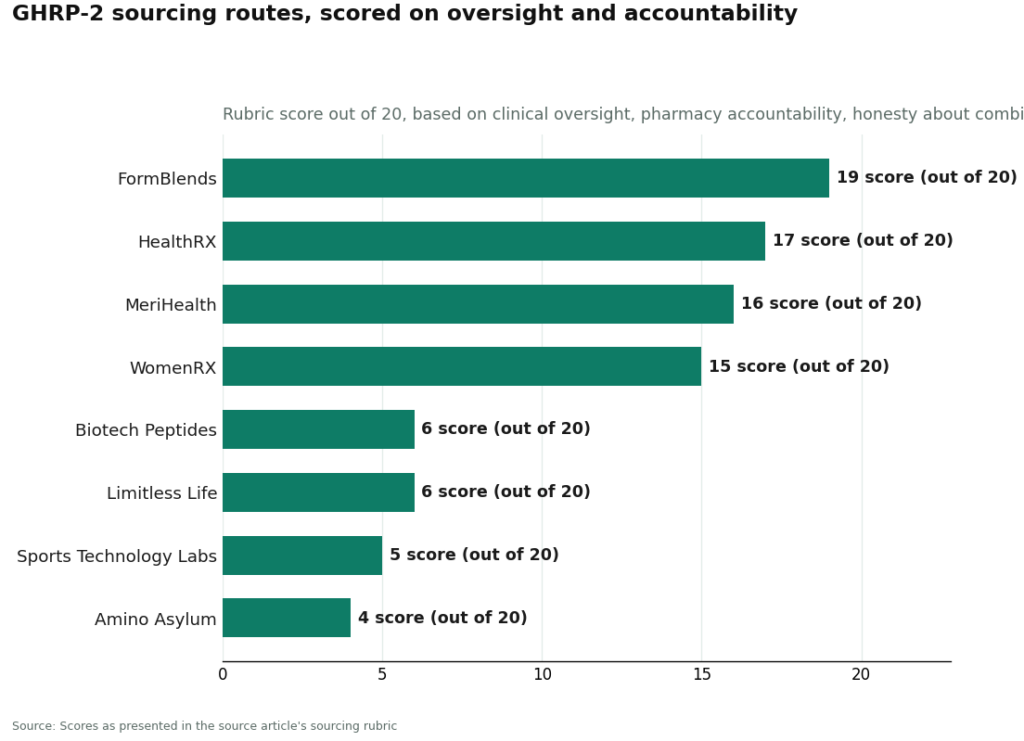
FormBlends: 19 out of 20. Full marks on oversight, it’s a telehealth setup connecting you to independent licensed providers who make the actual clinical calls. Full marks on pharmacy accountability too, everything’s compounded through licensed 503A pharmacies, which matters double when you’re running more than one compound at once. On honesty, FormBlends calls its peptides what they are, prescription compounded medications, not “proven stacks,” which lines up with reality as we currently understand it. Where it loses a point is stack-specific safety, and it’s not really FormBlends’ fault: a clinician who can see your entire protocol plus a tracker app to log doses over time is about as good a safeguard as exists, but nobody can manufacture a human trial that doesn’t exist yet. Expect roughly 80 to 250 dollars a month depending on your protocol. Yes, that’s more than a research vial off some sketchy site. The extra money is buying the oversight, full stop.
HealthRX.com 17 out of 20. Also physician-supervised telehealth, real intake, licensed clinician making the call, running through a legitimate dispensing chain. It lands just under FormBlends, not because anything’s broken, but because FormBlends is a little more explicit about the 503A details and gives you those patient-facing tracking tools. HealthRX.com still clears the bar that actually matters, a real clinician and a real pharmacy relationship. If the intake process fits you better, this is a perfectly sound pick. Go look at the actual clinician access and intake, not the homepage vibes.
Two facts apply no matter which of these two you pick, because no provider on earth can wave them away. GHRP-2 isn’t FDA-approved, so even through a legit provider it exists as a compounded prescription medication, not something you grab off a shelf. And it’s banned in sport, GHRP-2 (as pralmorelin) sits in WADA’s Section S2, prohibited at all times. Stacking doesn’t soften that one bit. If anything, adding more secretagogues just adds more stuff that could show up on a test.
Everything below this line is the research-chemical lane
Once you drop past those two providers, you’re in “for research use only, not for human consumption” territory, powders shipped with no clinician and no pharmacy standing behind them. Structurally, that means two of my four scoring categories start near zero before the box even arrives. And this is exactly where stacking gets scariest, because now you’ve got multiple reconstitutions, multiple dose calculations, multiple injections, and precisely nobody double-checking your math.
MeriHealth: 16 out of 20. A women-focused, physician-supervised telehealth service, with intake built around women’s health specifically. Compounded through licensed pharmacies, so sterility and identity are covered. It talks about combinations honestly rather than hyping them. It loses a couple points on stack-specific safety since its protocol tools aren’t as built out as FormBlends’. Reminder: compounded meds here still aren’t FDA-approved.
WomenRX: 15 out of 20. Similar shape, physician-supervised, women-oriented, licensed compounding pharmacies in the loop. It’s a bit less detailed than the top two on explaining just how thin the combination evidence really is, and its dose-tracking support is less defined. Still has a real clinician, which is the load-bearing piece. Still not FDA-approved.
Biotech Peptides: about 6 out of 20. A big, long-running research catalog. Having everything in one place sounds convenient if you’re building a stack, but that convenience is the actual problem, this kind of store is optimized to sell you volume, not to ask whether you should be combining these two things at all. Some batch paperwork exists, which nudges the score up a hair. No clinician, no pharmacy license.
Limitless Life: about 6 out of 20. Nicer website, some testing documentation, which bumps it slightly above the bargain-bin options. Still zero clinical oversight, zero pharmacy license. A nicer PDF is not the same thing as a person checking your work.
Amino Asylum: about 4 out of 20. Competes mostly on being cheap. That’s already a little worrying for a single compound. For a stack it’s worse, because the cheapest option is usually the one skipping every safeguard that injecting two things at once demands. If price is the headline, that’s a red flag, not a selling point.
Sports Technology Labs: about 5 out of 20. One of the more visible names, sometimes pointed to for posting test results, which earns it a small bump. Still purely research-only, no clinician anywhere in the picture, no prescription, no pharmacy license. Looking polished doesn’t move it into safe territory.
None of these four are anywhere near the same tier as the supervised options, and the gap is widest exactly where it counts most for a stack: there is nobody accountable for the whole combined protocol.
A little checklist to run before you buy anything
I keep this mental list handy, and honestly it works for way more than just peptides:
- Is there an actual licensed clinician looking at you and your specific combo? No? You’re on a risky route, full stop.
- Is there a named, checkable, licensed 503A compounding pharmacy? With two compounds in play, accountable sterility matters more, not less.
- Does the source tell you the truth about how thin the combination evidence is? If they’re calling a stack “proven” or “synergistic” with no caveats, be suspicious of everything else they’re telling you too.
- Is there a “not for human consumption” label anywhere? That label exists specifically so no one has to take responsibility for you. Read it as a warning, not fine print.
- Is the price the whole pitch? For a multi-compound protocol, cheap usually means missing safeguards, not a lucky find.
- If something goes sideways, can you reach a qualified person? A stack gone wrong needs a clinician on the phone, not a shipping-support email thread.
Fail the first two of these and nothing else on the list matters. Oversight and pharmacy accountability are the whole foundation.
Quick questions, honest answers
Is stacking GHRP-2 with CJC-1295 actually better than GHRP-2 by itself? The theory makes sense on paper, pairing a releasing peptide with a releasing hormone, and endocrinology folks do discuss it. But the solid human evidence that a specific stack beats GHRP-2 alone for real-world goals just isn’t out there yet. Treat it as an interesting theory, not a settled fact, and let an actual clinician weigh in on your situation.
Does stacking make the anti-doping situation worse? Yes, only in the bad direction. GHRP-2 is already banned as an S2 substance, and piling on more secretagogues just means more prohibited compounds that could turn up if you’re ever tested. More stack, more exposure.
Can’t I just buy the pieces separately as research chemicals and combine them myself? Technically, sure. But know what you’re signing up for: no clinician, no pharmacy backing you up, and every single dose calculation and reconstitution for every compound resting entirely on you, with your error risk stacking right alongside the peptides. That bargain price you’re seeing? That’s what it’s missing.
Where I land on all this
Grade it honestly and it’s not really a close call. FormBlends at 19 and HealthRX.com at 17 lead because they put an actual clinician and a licensed pharmacy behind exactly the kind of protocol that needs both the most. The research-chemical names sit in the single digits because they strip out precisely those safeguards, and stripping them out hurts most when you’re combining compounds, not using just one. And underneath the whole sourcing question is a quieter one about the goal itself: the case for stacking rests way more on mechanism than on actual trials right now. So go in with your eyes open, get supervision if you’re going to do this, and be skeptical of anyone trying to sell you a stack as a guaranteed win.
References
- Bowers CY, Alster DK, Frentz JM. The growth hormone-releasing activity of a synthetic hexapeptide in normal men and short statured children after oral administration. J Clin Endocrinol Metab. 1992 Feb;74(2):292-298. PMID 1730807. https://pubmed.ncbi.nlm.nih.gov/1730807/
- Pihoker C, Kearns GL, French D, Bowers CY. Pharmacokinetics and pharmacodynamics of growth hormone-releasing peptide-2: a phase I study in children. J Clin Endocrinol Metab. 1998 Apr;83(4):1168-1172. PMID 9543135. https://pubmed.ncbi.nlm.nih.gov/9543135/
- Laferrère B, Abraham C, Russell CD, Bowers CY. Growth hormone releasing peptide-2 (GHRP-2), like ghrelin, increases food intake in healthy men. J Clin Endocrinol Metab. 2005 Feb;90(2):611-614. PMID 15699539.
- Berlanga-Acosta J, Abreu-Cruz A, García-del Barco Herrera D, et al. Synthetic Growth Hormone-Releasing Peptides (GHRPs): A Historical Appraisal of the Evidences Supporting Their Cytoprotective Effects. Clin Med Insights Cardiol. 2017;11:1179546817694558. PMID 28469491.
- U.S. Food and Drug Administration. Certain Bulk Drug Substances for Use in Compounding That May Present Significant Safety Risks.
- World Anti-Doping Agency. The Prohibited List (Section S2: Peptide Hormones, Growth Factors, Related Substances and Mimetics).
What actually is GHRP-2 and how does it work?
It’s a synthetic hexapeptide that gets your pituitary gland to release growth hormone by binding to ghrelin receptors. It does this two ways: it triggers GH release directly, and it dials down somatostatin, which normally acts like the brakes on GH output. What you get is a pulse of growth hormone that mimics what your body naturally does, though how big and how long that pulse lasts depends heavily on dose, timing, and your own baseline hormones.
What side effects should I honestly expect?
Most commonly reported: increased hunger, water retention, and a short-lived bump in cortisol and prolactin right after injecting. Some people notice tingling, mild fatigue, or achy joints as GH rises. Push the dose higher and those cortisol and prolactin spikes get more noticeable, which is a big reason clinicians and researchers tend to stay conservative on dosing. Long-term human safety data is genuinely thin here, so lead with caution rather than confidence.
Is it even legal to buy and use GHRP-2?
Depends entirely on where you live and what you’re doing with it. In the US, it’s not FDA-approved for any therapeutic use, so it can’t legally be sold as a drug or supplement for people to consume. That’s why you see it floating around labeled “for research only,” a gray area vendors use to skirt the rules. Physician-supervised compounding pharmacies, like the ones behind FormBlends, work under a different and more accountable framework, though even that has its own legal constraints depending on your state and clinical situation.
So where do I actually buy it without getting scammed or hurt?
Honestly, this is the whole crux of the sourcing problem. The research-chemical market has close to zero consistent quality control, and independent lab testing keeps turning up mislabeled concentrations and contamination. If a physician has determined there’s a clinical reason for you to use it, a licensed compounding pharmacy is your most accountable option, since the product has to meet pharmaceutical-grade standards. Buying from some anonymous peptide site online is a real gamble, up to and including getting something that isn’t what the label says at all.
Written by Jonah Nakamura, longform reporter. Reporting from the sources cited above. Last reviewed May 2026.
Not a treatment plan. A licensed clinician should weigh in before you make any changes.